Back
Back
Samuel - December 7, 2024
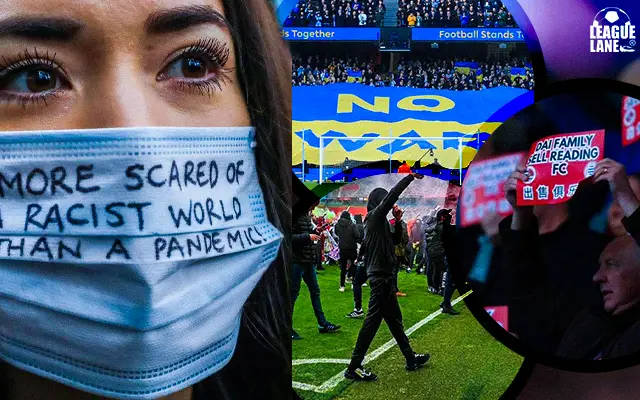
Several players across European clubs have led protests in football to support a claim and express their views on a particular pressing problem.
Football players frequently convey their sentiments on a specific topic through variety of demonstrations both on and off the pitch.
Footballers often come together in a league to protest a certain issue or players in a team can express their view on a matter that is of great interest to them.
Furthermore, individual protest and demonstrations by players can be depicted on the pitch by revealing undergarments phrases or inscriptions.
However, there are various rules according to the International Football Association Board that regulates how players can demonstrate about a particular issue on the pitch, which we will be analyzing.
IFAB rule states that players’ equipment must be free of political, religious, personal slogans, declarations or images.
Footballers are also prohibited from wearing undergarments with political, religious, personal messages, as well as advertising other than the manufacturer’s emblem.
This implies that players cannot demonstrate or lead a protest on the field due to political, religious or personal reasons.
The rule according to Law 4 applies to all on-field players, substitutes, as well as team officials in the technical areas.
Footballers are permitted to only wear only their name, number, team crest, slogans or emblems promoting the game of football, respect and integrity and any advertisement authorized by tournament rules or FIFA.
Any player found guilty of the aforementioned infraction by the International Football Association Board will face sanctions by the competition organizers or FIFA.
Knowing that rules, let’s look at some of the player-led movements in football over the past years.
This was one of the most significant player-led movements in football, and it was consistent through various competitions.
This practice began in 2020, after the murder of US citizen George Floyd by a police officer, as Premier League players began kneeling before kickoff to demonstrate solidarity with the Black Lives Matter Movement.
England men’s and women’s footballers began taking the knee during European competitions that took place in 2021 and 2022.
However, the initiative has been evolved over time, with players now taking the knee at the league opening and final game rounds of the season, with the Premier League stating that the gesture is intended to “demonstrate their ongoing commitment to fight racism and all forms of discrimination”.
Vinicius Junior led a social media protest against racism, which was aided by other footballers after the Brazilian was racially abused by some Valencia supporters during a league game at the Mestalla stadium in May 2023.
This was motivated by the escalating racism towards black players in La Liga over the years, and several players have supported this protest.
However, the Spanish Football Federation took swift action against the fans who racially abused Vinicius Junior, issuing a two-year ban from attending any football game,
Players participated in protests during the 2022 World Cup qualifiers to draw attention to Qatar’s treatment of migrant workers and human rights records, which have been ongoing since the country was awarded the right to host the tournament.
Footballers protested on the field against the terrible working conditions and lack of rights for migrants’ workers working on-site in the World Cup stadiums.
The Dutch national team players wore t-shirts with the message “Football supports change”, while the German national team players lined up in black t- shirts with inscriptions spelling out “HUMAN RIGHTS”.
The Rainbow Laces campaign is a partnership between the Premier League and LGBTQ+ charity stonewall.
Players wear rainbow-colored laces and captains’ armbands to show their support for the LGBTQ+ community, encouraging equality and diversity.
Since it’s inception in 2013, all team in the league and the significant majority of Premier League captains have backed this initiative.
However, Crystal Palace captain Marc Guehi wore the rainbow armband against Newcastle but wrote “I heart Jesus” on it, attracting the attention of The Football Federation (FA).
The FA decided not to take action against the English defender while warning both the club and the player that religious messages on their kit are prohibited, as stipulated in the FA kit regulations.
There have been varied reactions from fans regarding player-led protest, ranging from negative and positive reactions.
The majority of favorable reaction are from fans who appreciate players’ unity and support and in raising awareness about social issues that affects people around the world.
In addition, Footballers who take a stand and utilize their platform to speak out on a particular subject are admired for their bravery and respect.
On the flip side, some supporters believe player-led protest should be avoided in football because politics and social issues should be kept separate from the sport. Some fans feel they pay to watch pure football, free of political or social issues.
Furthermore, some football lovers tend to boycott matches featuring clubs or footballers that support a specific cause because they feel players should focus solely upon the game and not use their position to spread social or political messages.
Footballers led-protest have been prevalent in football with several players stating their opinions on certain occurrences. The football governing bodies established rules that strictly restrict the type of messages sent out by players on the pitch.
However, as various issues emerge, fans will continue to have conflicting reactions to player-led protests.