Back
Back
Afolabi Ezekiel - November 20, 2024
Politics have always extended far beyond the governing and administrative sector to even the sports industry. Football being a universal language and an internationally acclaimed sports activity falls prey to many of these conflicts owing to political influence and interference in teams, players and fans.
The recent examples have shown that political tensions between states or within a continent affect league game, limit player transfers and at times, bar some teams from participating at international competitions.
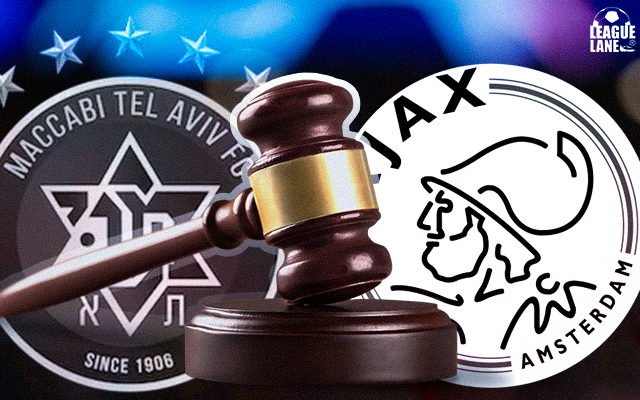
This piece aims at looking at a recent event that was held in Amsterdam where Maccabi Tel Aviv visited Ajax in the Europa league. And we seek to identify how those political shifts impact the competition over football, question the sport’s principles of unity and sporting ethos, and reconstruct its possibilities.
A regular European match between Ajax and Maccabi Tel Aviv ended in violent night as local police said there was an ‘unprovoked’ attack on Israelis in Amsterdam. Maccabi Tel Aviv of the Israeli Premier League, one of 36 teams that will compete in the group stage of this season’s Europa League came into Thursday’s match on a three-game losing streak. But they were humbled 5-0 by Ajax and it was off the pitch incidents that brought condemnation across the nation.
There were riots in Amsterdam in the aftermath of Ajax’s Europa League match against Maccabi Tel Aviv before the International break. When Israeli supporters arrived in Amsterdam, local police said that some of them were attacked, and some of the attacked fans needed medical attention.
Previously, malicious activity of Maccabi fans was observed, which also caused tension during the stay in the center of the city.
Police stated that 62 people were arrested across the city on Friday the 8th of November during a news conference at Amsterdam after the fans who came to visit the football stadiums were attacked and some had fireworks thrown at them.
All five passengers that were taken to the hospital were later discharged, about 30 other passengers sustained minor injuries. Security forces had prior knowledge of possible confrontations during the moment of Maccabi’s performance because of the current war between Israel and Gaza and because the game fell on the anniversary of the Kristallnacht, a historical act of anti-Semitic pogrom.
Separately, the city authorities had called in 800 police officers and prohibited rallies in support of the Palestinians near the Ajax’s Johan Cruyff Arena.
Another Europa League match between Fenerbahce and AZ Alkmaar also involved a sizeable number of Turkish fans coming in to the city of Amsterdam. Some unrest came up early in the week when a Palestinian flag was vandalized and pulled off a building in the city center.
Police Chief Peter Holla has since acknowledged media accounts of Maccabi fans attacking a taxi and setting alight the Palestinian flag. About 1,000 Maccabi fans were led through Dam Square by police to the stadium where pro-Palestinian protestors were also present.
That evening and into the night, several Israelis, some shot and killed, were targeted in separate ‘hit and run’ attacks in different neighborhoods of Gaza City. Amsterdam’s mayor, Femke Halsema, claimed that police acted as well, transporting visiting fans to hotels by buses and bringing order about 3 a.m. local time.
Addressing a conference, Israel’s President Isaac Herzog revealed that King Willem-Alexander of the Netherlands told him he felt horror and shock at the incident. Maccabi’s supporters were filmed receiving instructions when disembarking the airplane not to display the Jewish emblem and were offered two “rescue flights” on the national airline El Al. For extra safety, police accompanied buses that transported fans to the airport as well.
In response, Halsema applied the emergency measures which includes banning demonstrations, prohibiting the usage of face masks, and providing police extra search capabilities.
Yes and No, in the sense that, while the violence was prompted by Maccabi’s presence, broader tensions surrounding the Middle Eastern conflict fueled the unrest. Amsterdam, with a substantial Islamic immigrant population, has seen frequent pro-Palestinian marches in the past year. Hosting an Israeli team was considered a high-risk event by local authorities.
The large presence of Maccabi fans did little to calm the situation, with footage circulating of supporters chanting anti-Arab slogans. According to the Athletic, verified footage showed fans in front of the National Monument on Dam Square chanting, “F*** you Palestine.”
Maccabi’s loyalists were accused several times of using racist slogans and that Thursday’s violence, unfortunately, stirred reactions of leaders of both Israel and the Netherlands acknowledging that the attacked had Jewish origins. “Our city has been dealt a severe blow by history” Halsema said in reference to Kristallnacht. That is, the culture of Jews has been in danger.
On Friday morning (November 9th) in order for the fans to get home safely, Maccabi Tel Aviv contacted the Ministry of Foreign Affairs and the Ministry of Culture and Sport in Israel. There was also an adoption to provide a special telephone number and address for the worried families; there was also an encouragement of adherence to the instructions provided by Israel’s national security office.
Maccabi’s team arrived back in Tel Aviv on Friday afternoon. Club chief executive Ben Mansford also described how he was deeply shocked at what had happened. What we were expecting to watch was a football match, but the story of today is not a match. Fortunately, all of us are safe.”
The club owner Mitch Goldhar remained in Amsterdam to identify missing fans who were reportedly taken to the hospital. The latter stated clearly that UEFA condemned these acts of violence in collaboration with Ajax and said that it would do what was even within its regulations concerning disciplinary measures.
Some football fans at Paris Saint-Germain showed a banner saying ‘Free Palestine’ in the match against Atletico Madrid in the Champions League while in the Europa League match, Galatasaray’s fans unfurled a similar banner during the match against Tottenham.
According to the UEFA’s disciplinary regulation, it becomes clear that clubs could be punished for ‘provocative messages’ of political, ideological or religious flag. Yet, this interpretation is with reference to context, and blind endorsement for a given cause is not likely to run a foul of UEFA policies in case the opposing side is Israeli.
The Palestine Football Association has lodged a complaint about the affair with FIFA, saying that Israel has violated humanitarian law. FIFA’s decision on potential suspension of Israel has been delayed several times and AFC has stood by PFA’s side. IFA President Shino Moshe Zuares described the allegations as something ‘venomous’ aimed only to destabilize Israeli football.
Maccabi’s next Europa League away match was to be against Besiktas, and although no official statements have been made, Turkish authorities and UEFA are to move the game to a neutral ground, the details of which are still unknown.
Political conflicts are increasingly influencing football, as seen when Maccabi Tel Aviv’s game against Ajax led to violence in Amsterdam.
Geopolitical tensions, especially the Israel-Gaza conflict, sparked antisemitic attacks against Maccabi supporters despite heavy police presence, resulting in arrests and injuries. Such incidents highlight how football events can become extensions of political disputes, pushing organizations like UEFA and FIFA to address political expressions at games.